Informa helps businesses and professionals in hundreds of ways.

Our international portfolio of live events, world-leading research publications, and innovative digital services provide specialists with the knowledge and connections they need to thrive.

Decorex Blog

Meet Natasha Mann: Decorative Artist Behind Decorex 2025 Branding & Design

Renowned decorative artist Natasha Mann has been selected as the Decorex 2025 creative collaborator, bringing her distinctive geometric patterns and traditional painting techniques to this year's show branding. Trained in Moroccan decorative painting and holding an MA from the King's Foundation School of Traditional Arts, Natasha specialises in hand-drawn geometric designs using natural earth pigments, egg tempera and 24-carat gold leaf.

In this exclusive interview, Natasha shares her artistic journey from Morocco to London, her design process, and what it means to collaborate with Decorex as this year's featured creative artist.

Natasha's designs are the focal point of the 2025 creative and will be featured in the pre-show marketing across the Decorex, website, social media, emails and print ads and across the show floor.

Discovering Artistic Passion: From Moroccan Design to Decorative Painting

How did you discover your artistic passion and talent?

From a young age, I was always drawn to decorative art and pattern with a particular fascination for Moroccan and Andalusian design. When I was 21 I moved to Morocco and spent a year doing an apprenticeship in Moroccan decorative painting on wood which really deepened my interest in decorative painting and ornate interiors.

What was your career journey?

As a teenager, I developed a strong interest in Moroccan design, which led me to pursue a degree in Arabic at university. Following this, I moved to Morocco to complete an apprenticeship in traditional decorative painting on wood.

After moving back to London I studied for an MA at the King’s Foundation School of Traditional Arts in Shoreditch which really transformed my painting journey. During the two-year course, I studied geometric design in depth and learned traditional painting techniques using natural pigments and egg tempera. This training profoundly shaped my artistic practice, instilling in me a deep appreciation for natural materials and the discipline of preparing my own pigments—now an essential and integral part of my work.

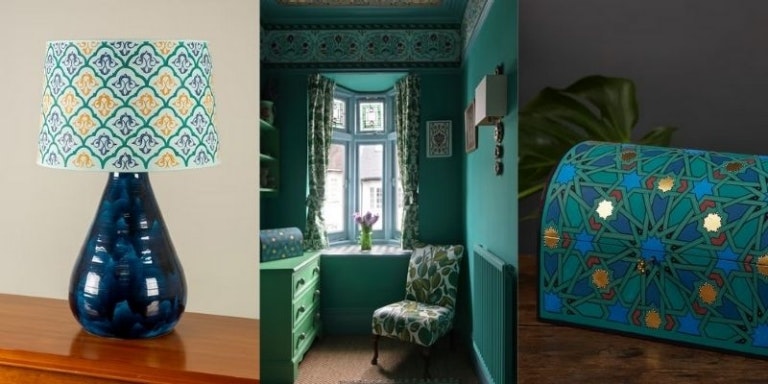
I now work with clients on interior projects; painting panels for ceilings or walls as well as furniture and smaller pieces such as boxes. In recent years I have particularly focused on lampshades, creating a collection for Vaughan as well as individual shades for clients and designers.

I also really enjoy teaching and have taught many courses abroad and in the UK.

The Decorex Journey: From Making Spaces to Creative Collaborator

I applied for Decorex Making Spaces having found out about the opportunity through my QEST (Queen Elizabeth Scholarship Trust) scholarship, which supports excellence in British craftsmanship. 

Having visited Decorex for many years and recognising that much of her work aligns with the interiors industry, I had wanted to exhibit there for a while. Having a stand as part of Making Spaces was hugely beneficial as I met many interesting people and had several commissions as a direct result of exhibiting.
Decorex 2025 Design Concept: Victorian Influences and Geometric Patterns

Please tell us about your design concept for the 2025 Decorex show creative?

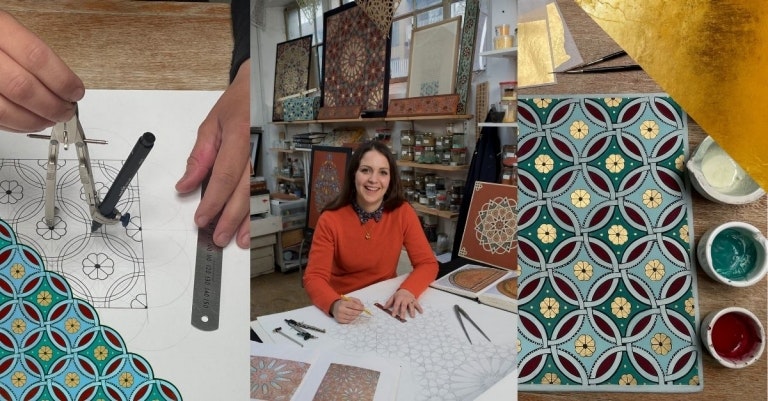
I wanted to create a geometric pattern using Victorian influences, to celebrate the origin of the building. The concentric circles and flowers in my design echo the shapes in the facade of Olympia and along the balconies. My final design is hand-drawn using a compass and ruler and then painted using natural earth pigments mixed with egg tempera and 24ct gold leaf.

What was your design inspiration/influences?

I spent time researching Victorian architecture and decorative arts to inform and inspire my design. Aside from observing the architecture of the Olympia building, one particularly valuable source was The Grammar of Ornament by Owen Jones, a comprehensive catalogue of ornamental design. His book encouraged me to draw from historical references whilst creating a design that feels modern and relevant today.

Can you talk us through your creative process?

It depends what design I am working on but normally I begin by looking through books with images for inspiration - this could be textiles or architectural examples. I have an extensive collection of books on textiles, architecture and decorative arts from around the world, as well as photos, which I refer to frequently for all my projects. I then start sketching ideas or if it’s a geometric pattern I will work on some designs using my compass and ruler. Once I’m happy with the design I begin by working on the colour using my collection of pigments. I normally make small swatches with examples of different colour combinations before deciding on the final piece.

The Significance of Collaborating with Decorex

It was a complete surprise and a huge honour to be asked to create a design for Decorex, as I’ve been visiting the show for years. I am really looking forward to seeing the designs in person in October.


About Natasha Mann

Natasha Mann is a London-based decorative artist specialising in geometric design, traditional painting techniques and bespoke interior commissions. Trained in Moroccan decorative painting and holding an MA from the King's Foundation School of Traditional Arts, she works with natural earth pigments, egg tempera and gold leaf to create hand-drawn geometric patterns for walls, ceilings, furniture and lampshades.

Her work has been featured in collaborations with Vaughan and numerous private clients and interior designers. 

Join the Conversation

Subscribe to our newsletter or follow us on social media for more design news, exhibitor highlights and trend insights, and save the date from 11 to 14 October for Decorex 2026 at Olympia London.